Welcome to Terry Tempest Williams: Coyote Clan. My name is Rose Z. Moonwater and I am the "editor" of this site. Below is some info about me and how this site came to be.
Much Closer to Home
When I was a kid, growing up in Los Angeles, California, there were a few things that gave me solace. One was discovering Audobon magazine, and soon after, the poet Robinson Jeffers. The next was finding animals around the neighborhood, whom I would "borrow" for company. The third thing was once a year travels with my parents, many times to Estes Park, Colorado, or to my uncle's lodge in the interior of British Columbia.
At sixteen, I backpacked for the first time. When I was 19, I left L.A., and moved to Santa Cruz, CA, and then on to Colorado, and New Mexico. I stayed in New Mexico for a chunk of time, before returning to California. The Southwest changed me, it inhabited me. I had finally found a place, a landscape, that felt like home.
Throughout my life, writers and musicians have provided hope and inspiration, finding others who care about the Earth, and wildness, and animals. In a way, it is out of loneliness and that search for others that this website was born.
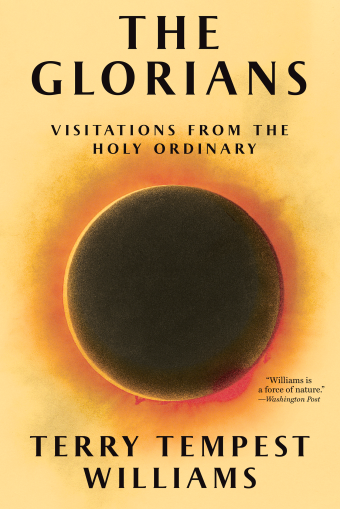
I was first exposed to the writings of Terry Tempest Williams about 10 years ago. Traveling with a friend in Arizona, Coyote's Canyon tapes fell from the shelf of a ranger station right in front of us, and we had to have them. We listened to those tapes in the car as we traveled in Arizona, the perfect complement for our journey. When I came home, I read everything of Terry's that I could get my hands on.
Over the years, Terry's voice became allied to something in me that values place. She insisted that a sense of place could be honored, and that love for land, and wildness, called for certain actions. Terry's stance is radical in her refusal to abandon what she loves.
Through loss and heartbreak, we come down to what is essential. I adore the Southwest. Slowly, slowly, I awakened to the need to fight for the land that I love.
This site was first conceived of in March 2000, and finally came to be in September 2001. I was compelled to create this site. Does any of us know what is inhabiting us? I looked for Terry's work on the web and found pieces scattered everywhere. I wanted there to be a central place to find her work, and knew how to create such a place.
I wanted to honor Terry's work and to stand as an ally beside her words, her work. I hope her revolutionary consciousness will echo down to the bones of your own truth, and that the wild love she speaks of and stands for will resonate, as each of us, in our own way, live our responses.
This site is dedicated to the Coyote Clan--to all who work on behalf of the Earth and all creatures.
Thank you
to Clytia Fuller for the domain name suggestion; to Clytia and Eric Schoeck for assistance with introductions; and to Marianne Merola, for all her assistance.
See more about my
web design work, or reach me
directly.
Here is a story about a place I loved in New Mexico.
Frank's Land
Many years ago, I lived in a high mountain valley outside of Tesuque, New Mexico, along the back road to the ski basin, at 8500 feet. The land was owned by Frank V. Ortiz, an oldtimer.
Living in that valley was like living inside of a deep embrace, with the mountain behind me I thought of as "The Watcher." The land was surrounded by National Forest Land to the west, and a spiny ridge road along the east. The road was unpaved, but a pretty good road, considering all the kinds of weather we had.
Tesuque is about 15 miles north of Santa Fe, and recently featured in the Santa Fe paper for hungry bears wandering down out of the mountains, roaming around town, and sitting up in the trees during daylight hours. When I lived on that mountain, we would see those bears really early in the morning, down in the orchards, in fall.
I lived in a cabin with a wall of windows that bordered Little Tesuque Creek, and there was a spring, or "ojo," up the driveway, with an outlet near the creek, from where I hauled water. Living near a spring is such a blessing.
The land had a lot of other features. There were 400 apple trees, planted by Frank, red delicious, golden delicious, and especially delightful jonathans, that developed a water core bursting with tartness after the first freeze. There were wild apricot trees, and the ditch system which New Mexico is famous for, and acres of alfalfa. There were two other houses on the property at that time, screened from sight by cottonwoods bordering the creek, but visible once you crossed the bridge over the creek. I depended upon those neighbors for the nearest phone, showers, and friendship, too; news of bear sightings, or cowboys rounding up the cattle that came down from grazing the high country as the days shortened.
There was a pond on the land, edged with cattails and the juiciest rose hips. My dog and I would cool off after work with a swim in that pond on summer afternoons. My dog roamed the valley during the day, and visited neighbor dogs, but always met me at the top of the drive when I returned from work. Sound was distinct in that valley, and traveled a long ways. Especially the sound of a truck bouncing up the rutted road, then leaving the road and starting down the drive, rattling the cattle guard. That big, red dog would meet me at the transition, tail flag held high, and proudly lead the way curving around the rising hills, across the creek, to the final straight stretch of the forest boundary to home.
There was also a deep quiet in that valley, and a load of stars on moonless nights, or fascinating moonshadow shapes on moonfull nights. That deep dark, moving around the valley at night, taught me to trust my instincts. Walking through the oak grove, I would sense, rather than see, the barbed wire rising up to meet me. Losing depth perception along with sight hinders movement in the dark. Trusting the bottoms of your feet, finding the path down valley to meet with neighbors, restores a different kind of perception. The sense of being a moving body within a body, cradled by almost seen landforms, became another touchstone; to know one's place in the scheme of things. I really miss having that sense of myself in the city, the sustaining sense of knowing things intimately, as I did on that land. Hauling water, keeping the wood pile high, and trudging in from the highest point of the road in winter to avoid getting snowed in, all seemed harsh at the time and are considered primitive, yet led to a deep sense of knowing how to survive in that place.
Care of the orchards and the imperative of the elements structured the days, and brought a lot of seasonal rituals. Picking apples, pressing cider, and taking apples to town, were some of the best loved rituals. Frank would slant his pickup truck under the trees, and I'd climb up on the cab with a picking sack, while he stayed below, telling me stories, and seeing how far he could pull the leg of a "girl from California."
The goldens actually juiced green in the jar, and the jonathons pressed a fine pink juice, changing to brown in about a half an hour. I adored those apples. There was pruning, and cleaning out the ditches, and distributing the apples in fall, and drying apples and apricots. We had to keep the drying racks away from trampling cows and bears and other roaming critters, so the best place was up above in the reflective heat of the black, shingled flat roof.
I left Frank's land one October under a gray, lowering sky, flakes swirling in the air, trying to avoid getting snowed in, with cats, dog, piano, and a Uhaul on the back of my '57 Chevy pickup truck. Back to California, where I had come from, back to family. My entire family came from other continents, with those different memories, languages, and cultures. They moved to the U.S. the year before I was born, but still thought of me as the "first American" of the family. They all live in Los Angeles. My family's stories and journeys had always dwarfed my own, their lives entangled with tragic history.
The experience of living on Frank's land abides in me far longer than the physical time that I actually inhabited the house on his land. During the intervening years I have lived in California, mostly in Santa Cruz. I have struggled for all of these years with the question of where is home. If anything, the unfolding years have answered by showing me how much New Mexico means to me, how much it still feels like home.
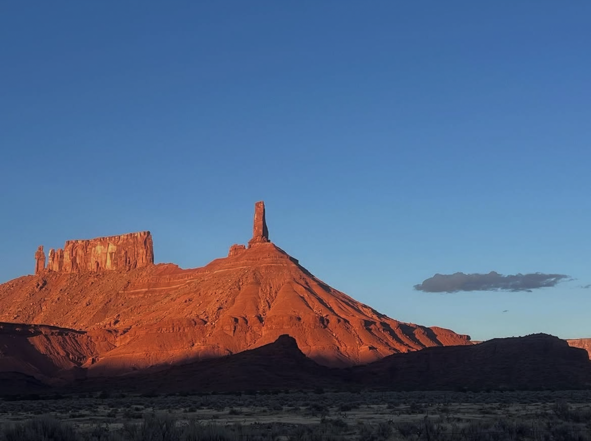
I come back to New Mexico, Utah, and southern Colorado as often as I can, often several times a year, sometimes once every several years. Over the years the sense of "home" has broadened to become anywhere in the Southwest.
There is so much to discover in this "home." I prefer to come to one little spot on the map, one canyon, for an entire trip. Sometimes I come and stand in one area and paint. Sometimes I come and walk down a river. But I am always called back. Sometimes I have come and said, okay, now what is it you want from me? And the answer that I lived my way into was that I needed to see the light.
I have learned some different things here in California about a sense of home. I have learned to honor and appreciate a sense of place, by living in exile from the land I love. I have stretched time away from home, wondering whether I deserve to return home to what I love. Must I earn living in a place that I love? Is it something I am allowed to have? Will I choose to honor my need for land and space and light, a land that I love to look at, a sustaining land? A voice tells me I am not thinking big enough.
I am sure this story is to be continued...