911: In Response to Place
by Terry Tempest Williams
We were gathered at the Corcoran Museum of Art in Washington, D.C., to
participate in the opening of a new exhibit entitled "In Response to Place"
sponsored by The Nature Conservancy. Twelve American photographers had been
invited to cast their eyes in the direction of wild, open spaces and make
art. Among them, Annie Leibovitz took her camera to the Shawangunk Mountains
in New York. Mary Ellen Mark traveled north to the remote Pribilof Islands in
Alaska. William Christenberry focused on the Bibb County Glades in Alabama.
Sally Mann sought light within the Calakmul Biosphere Reserve in Mexico.
Terry Evans photographed the Tallgrass Prairie. Karen Halverson made pictures
on the Cosumnes River in California. Lynn Davis found an architectural
presence within the redrock arches of southern Utah. And Richard Misrach kept
his eyes at home, in the Lahontan Valley of Nevada, in the desert where dunes
rest as bodies.
It was Tuesday morning. Andy Grundberg and I joined half a dozen of the
photographers in a book signing. We were responsible for some of the words.
We were scheduled for a mid-morning press conference. The conversation
around the table was about the enduring grace of landscape, how this
assignment had allowed them to see the world differently.
The conversation shifted to a discussion of death. Sally Mann spoke of
her
latest project, images that explore how the Earth changes death and how death
changes the landscape, even our perceptions of that landscape.
"It will disturb," she said.
"We are so frightened," someone added.
"Why do we turn away from what is inevitable?" another spoke.
"If we can begin to find peace in death, perhaps we can -- "
"Two planes have just crashed into the World Trade Center. Both towers--"
a
woman from the Corcoran says, entering the room with a cell phone still to
her ear.
Conversation stops. The signing of books stops. Bill Christenberry
quietly gets up to call his daughter who is attending NYU. Richard Misrach
says his son is in the city. Lynn Davis and Mary Ellen Mark both live in
Manhattan. I flash to my niece, Libby, a freshman at NYU. We cannot grasp
what we have just heard. There is no television to turn on to see or believe
with our own eyes.
Minutes later, a security guard enters. "We have to evacuate now, the
Pentagon's just been struck-- we have reason to believe the White House is
next-- go."
Adrenaline storms my body. The Pentagon? The White House? What is
happening? What to do? We all stand, stunned. Sally immediately says anyone
who wants to drive home with her to her farm in Virginia is welcome. We
gather ourselves. I grab Richard's hand, we run through the empty museum and
onto the street. I hear someone
quietly say, "Our work is now irrelevant."
Outside, my first instinct is to look up. There is a commercial plane
overhead, shining silver. I turn in the direction of the Pentagon. Is that a
dark plume of smoke rising? Chaos is growing. People are fleeing from the
White House, running across the lawn. Everyone seems to have a hand on their
ear, cell phones either calling out or calling in. Employees from the
Executive Office Building are exiting in mass on the corner of Seventeenth
Street and New York Avenue. Cars are honking. Emerging gridlock.
The next thing I know, I am being shoved into a cab with Richard, Mary
Ellen, Lynn, and Karen, four of us in back, two in front. The cab driver
turns around and asks, "And just where would you folks like to go?"
In the lobby of the Mayflower Hotel, we stand shoulder to shoulder with
everybody else who has come in off the streets, maybe a hundred people or
more, and watch the television screen. We watch replays of the first plane
hitting the tower, then the second. We gasp, we cry, we shake our heads in
disbelief and horror. People have their hands over their mouths. No one is
speaking. We are watching, with the whole nation and the world, we are
watching.
I pull out my notebook from my bag and take notes, a nervous compulsion:
Washington, D.C.
9.11
10:12 a.m.
Terrorist attacks. The twin towers burning. Smoke. The smoke clears. We
watch the south tower collapse. Before our own eyes. 102 stories. Thousands
of life stories. Gone. Collapsed dreams. Compressed sorrows. Shattered
innocence. Blood. They are already saying what they need from us now is
blood.
10:29 a.m.
The second tower is now collapsing, a fountain of smoke, steel, and glass,
cascading, descending, falling, down, down-- all this in the midst of
shimmering, sparkling bits of paper and glass reflecting light, holding the
light, even in darkness. Descending darkness. Birds falling? They are
people falling. "My God," a man cries. "Mercy," another responds. The woman
sitting on the couch is weeping. Cameras shift to the Pentagon. "Oh,
Jesus." The young man sitting on the floor next to me is rocking back and
forth. "Tom, please be alive, please be alive." He is a security guard at
the Pentagon who tells me he had just left to go to a doctor's appointment
thirty minutes before the attack. "That's my post. They won't let me back
in. I know all the people in those offices. Tommy's my partner-- Please be
alive, please be alive." He keeps pressing Redial on his cell phone. "Come
on, Tom, answer, answer." He clicks off. "Dammit, I can't get through."
10:40 a.m.
"This is war-- " declares Peter Jennings.
Live coverage from Washington, D.C. We are in Washington, D.C. It's hard
to tell whether the sound of sirens is coming from inside the television or
from outside on the streets. First words coming out of the Pentagon say there
may be eight hundred
dead. Nobody knows. Nobody seems to know anything. Here we are in the seat of
power, standing in terror, as fear and uncertainty are locked in our bodies.
Where is the president? Where is Dick Cheney? Within minutes, Washington,
D.C. is transformed into a police state. Black-shrouded snipers are perched
on the roof of the White House like ravens.
New York City is burning.
The Pentagon is burning.
They say what they need from us now is blood.
I am back on the street, alone, never have I felt more alone, far from
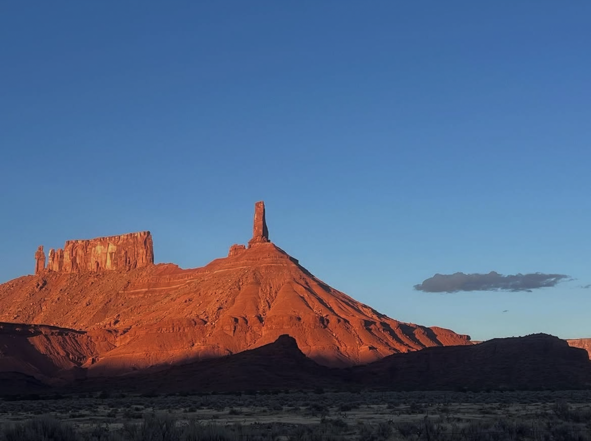
my home in the redrock desert of Utah. I cannot reach home. All phone lines
are jammed. In my bag, I remember I have a small piece of sandstone that I
brought from home, a talisman from the banks of the Colorado River. I stop in
the middle of the sidewalk, find it, and hold it tightly in the palm of my
hand like a secret and then continue walking in the steady stream of people,
dazed, distracted, and scared.
Chaos is controlled by a strange stoicism living on the streets,
everyone is trying to leave, call it escape, cars bumper to bumper, this time
no horns are honking. It is an orderly fear. I see faces staring straight
ahead. Windows rolled down. Radios on. Some cars are being abandoned, people
resolutely walking across the Fourteenth Street Bridge like refugees. Four
fighter planes scream overhead, flying low, so low. I can see numbers painted
on their bellies, F-16s wheeling right, then left in the direction of the
White House. Yellow police tape is wrapped around city blocks like its own
terrorist package. I cannot get to my hotel. Flags are already flying at half
mast. I just keep walking the streets, watching, listening, observing, no
place to go, where can I go?
A Palestinian kneels in the middle of the intersection on I street and
Seventeenth, crying, "I didn't do it, you Americans did it." Traffic is
halted, creating a barrier. A crowd gathers around him. A stone in my hand.
And just where do we go now to believe the myth of our own making, that there
are places on this planet immune from suffering?
Used by permission of the author. May not be reprinted or used without permission of the author and Brandt & Hochman Literary Agents, Inc.